Reply in 1 business day
Free trimming estimate
Tell us which tree and what bothers you about it. Photos speed things up.
We'll call you within one business day. If a tree or limb is on your house right now, call (352) 301-4164 and we'll move you up.
Trim it right. Keep the tree.
We prune Gainesville’s live oaks, laurel oaks, magnolias and palms the way they’re meant to be pruned: clean cuts at the branch collar, no topping, no spikes on living trees. Limbs come off the roof, light comes back to the lawn, and the price goes on paper before a climber ties in.
Reply in 1 business day
Free trimming estimate
Tell us which tree and what bothers you about it. Photos speed things up.
We'll call you within one business day. If a tree or limb is on your house right now, call (352) 301-4164 and we'll move you up.
Good pruning is mostly knowing what to leave.
A Gainesville oak can carry limbs forty feet long over a roof, a driveway and the neighbor’s fence at the same time. Trimming it well means choosing a handful of the right cuts, not taking everything within reach.
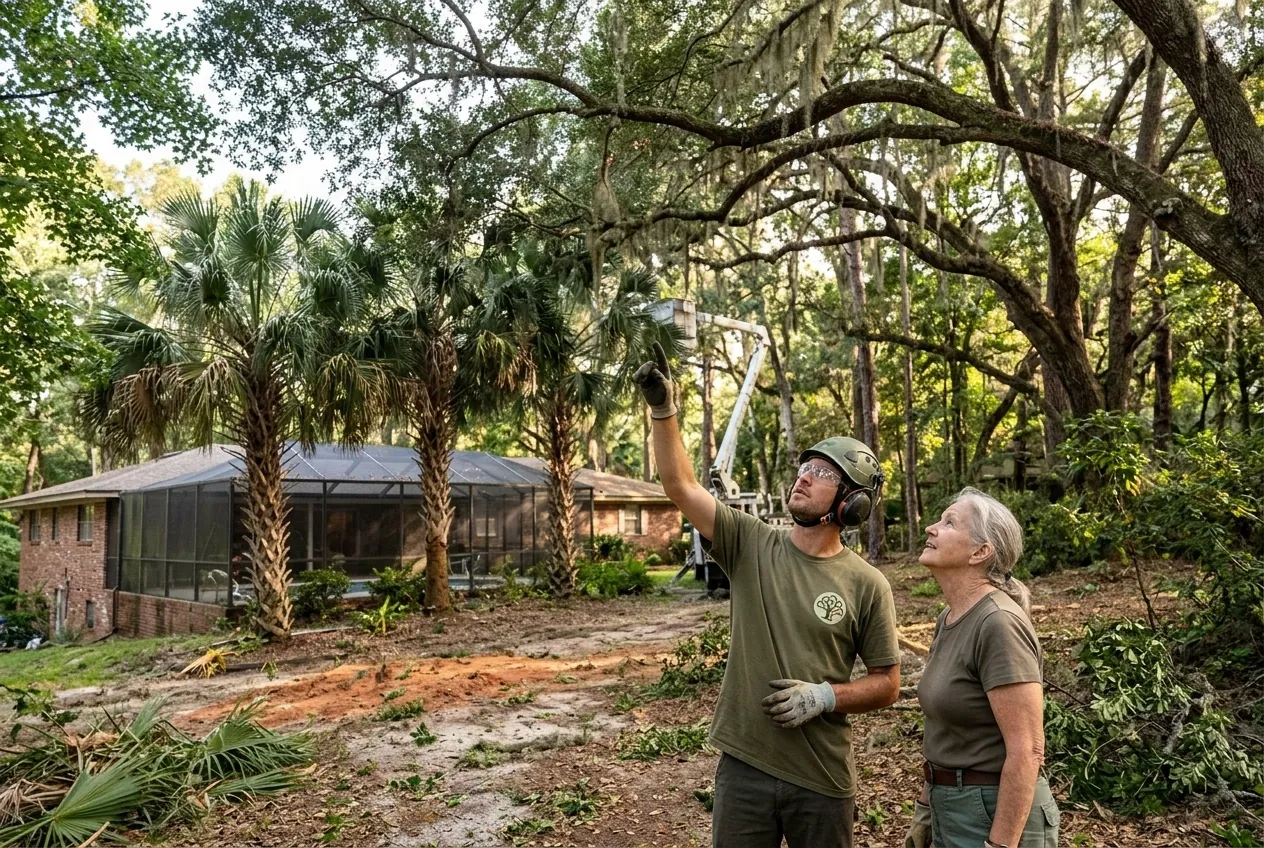
On the estimate we walk around the tree with you, point out the limbs that matter and explain why each one should go or stay. Some yards need full tree trimming with clearance, thinning and deadwood in one visit. Others only need a few selective pruning cuts to fix a weak fork. If the honest answer is to wait a year, we tell you that too.
Four steps, no guesswork.
You know which limbs are coming off and what it costs before the crew shows up.
A couple of pictures of the tree and what’s under it are often enough for a rough range.
We point out the cuts we’d make and why, then write one fixed price.
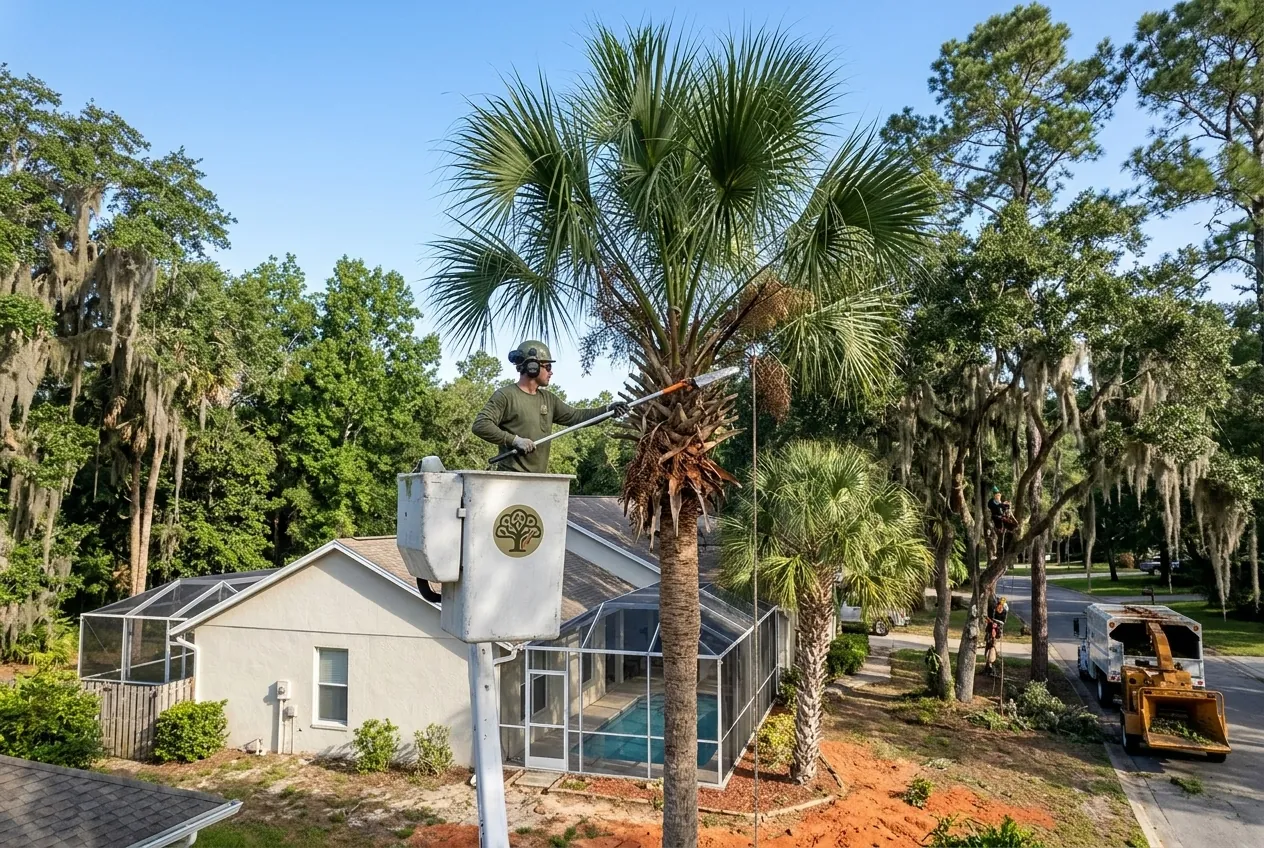
Climbers on rope or a bucket truck, limbs lowered over roofs and screens, nothing topped.
Brush chipped, wood hauled, lawn raked, and before photos next to after photos sent to you.
Ten kinds of trimming, one careful crew.
Every service here is pruning work on trees that are staying put. The ranges are typical for one residential tree in Gainesville; your quote is a single fixed number.
Shorter, lighter limb ends and clearance over the house, with the oak’s natural spread kept.

Low branches lifted off roofs, walks, mailboxes and screen enclosures.

Brown fronds, seed stalks and loose boots off. Healthy green fronds stay on.

Dead and broken limbs taken out before the next thunderstorm drops them.
Full-tree trimming done to arborist pruning standards, not hacked.
$175–$900Selective cuts that fix structure and keep the tree healthy.
$200–$950Lets light and wind through dense oak and magnolia canopies.
$250–$900Shortens heavy ends without topping the tree.
$300–$1,200Pre-season pruning that lowers wind load on big trees.
$250–$1,100Structural pruning that sets new oaks up for 80 years.
$95–$350Same oak, room to breathe.
A typical job here: a live oak whose lower limbs have settled onto the shingles and whose crown has grown thick enough to keep the roof damp. The low limbs are lifted or shortened, the crown is thinned from the inside, and the tree still looks like itself from the street.
Three cuts do most of the real work.

Almost every trimming job we price in Gainesville comes down to some mix of thinning, raising and reducing. Each one solves a different problem, and picking the wrong one is how trees get butchered. Topping isn’t on the list because it creates more risk than it removes. We wrote up why topping fails if you’ve been offered it.
Older laurel oaks and southern magnolias pack their crowns with crossing, rubbing and inward-growing branches. Crown thinning removes a selection of those from the inside so wind and light can pass through, while the outline of the tree barely changes from the street.
Branches that brush the shingles, scrape the pool screen or block the view at the end of the driveway get removed or shortened from the bottom of the canopy up. Done in stages over a few years, raising keeps enough lower foliage to support a healthy trunk.
Live oaks love to grow sideways. When a limb stretches so far that its tip sags toward the roof, crown reduction cuts it back to a lateral branch big enough to take over, which shortens the lever without leaving stubs.
Trim before June. Sleep better in August.
Hurricane season starts June 1, and north Florida’s summer thunderstorms bring their own hard gusts on top of it. Both Irma (2017) and Idalia (2023) scattered broken oak limbs across Alachua County. Pruning ahead of time won’t stop the wind, but it changes what the wind has to work with.
Call (352) 301-4164 Mon–Sat 7am–7pm
We trim like the tree has to live here.
Because it does. A bad trim shows up three summers later as rot, sprouts and broken limbs, so we cut for the long run.
Every limb we take has a reason we can explain: clearance, structure, deadwood or wind load.
Your signed price covers the cutting, the chipping and hauling everything away.
Limbs above roofs, gutters and pool screens are roped down instead of dropped.
City of Gainesville and Alachua County codes treat trees differently. We know which one covers your lot.
You get a time window and a text when the truck is headed your way.
No hurricane cuts. Dead fronds and seed stalks go, the green canopy stays.
You pay for the cuts, not the height alone.
The same oak can be a $200 job or a $1,200 job depending on which kind of trimming it needs. Here is how the main cuts compare on a typical mature tree beside a house.
Long horizontal limbs shortened back to strong laterals.
Thinning, reduction and deadwood aimed at wind load.
One leader chosen, weak forks corrected early.
Per palm, depending on height and species.
Only for trees on structures during active weather.
To check what a bid actually covers, read how to read a tree trimming quote before you compare bids. Full trimming price list
Each species here wants a different trim.
These are the trees we prune most in Alachua County yards, with the trimming each one usually needs and the typical cost for a single residential tree.
| Species | Upkeep | What the trim fixes | Usual pruning job | Typical range |
|---|---|---|---|---|
| Live oakQuercus virginiana | High | Long, low limbs drifting over roofs and lawns; heavy ends that pull on the main forks. | End-weight reduction | $300–$1,400 |
| Laurel oakQuercus laurifolia | High | Dead branches high in the crown and dense regrowth around old wounds. | Deadwood & thinning | $250–$900 |
| Water oakQuercus nigra | Medium | Brittle twigs and limbs that shed in summer storms. | Deadwood removal | $150–$700 |
| Southern magnoliaMagnolia grandiflora | Medium | Branches growing down to the ground and pressing on gutters. | Crown raising | $175–$650 |
| SweetgumLiquidambar styraciflua | Medium | Tall, narrow crowns leaning toward light and dropping spiky seed balls on walks. | Thinning & clearance | $250–$900 |
| Loblolly & slash pinePinus taeda / elliottii | Low | Dead lower branches and the odd broken limb hung up in the crown. | Deadwood removal | $150–$700 |
| Young shade treesOaks, elms and maples under 15 years | Low | Competing leaders and tight forks that become splits later. | Structural pruning | $95–$350 |
| Sabal & queen palmSabal palmetto / Syagrus romanzoffiana | Low | Brown fronds, seed stalks and fruit that mess up pool decks. | Palm trim | $85–$275 |
The city, its neighborhoods and four nearby towns.
Main service areaGainesville, FLTree trimming for the entire city lives right here.
What people ask before we prune.
For one tree, plan on $175 to $900 in most yards. Lifting low limbs off a roof usually runs $175–$650, a full crown thin $250–$900, and shortening the long ends of a big live oak $300–$1,400. Palms are priced per palm at $85–$275. After we see the tree you get one fixed number in writing.
Structural pruning on live, laurel and water oaks goes best from late fall through winter, when growth slows and the leaves are easier to see through. Dead limbs, roof clearance and anything hanging over a walkway can be cut any month. We like to finish big storm-prep jobs before hurricane season opens on June 1.
Far less than most people expect. Pruning standards generally cap a single visit at roughly a quarter of the live foliage, and on older oaks we usually stay well under that. Taking too much at once starves the tree and triggers a flush of weak sprouts.
Topping cuts big limbs back to stubs with no regard for where they branch. The stubs rot, and the shoots that grow back are poorly attached and break easily, so the tree ends up more dangerous a few years later. Crown reduction shortens a tree the right way by cutting back to a healthy side branch.
Ordinary trimming almost never calls for one. The permits you hear about are mostly for removals, such as heritage-size trees on single-family lots inside city limits. The City of Gainesville code does set pruning specifications that prohibit cuts which create hazards or cause decline, and unincorporated Alachua County has its own code. Our permit guide covers the details.
Every three to five years suits most established live oaks in Gainesville yards. Young trees benefit from a lighter visit every two or three years while their structure is still being set. Trees over a roof, pool cage or driveway may need clearance work a little more often.
No. UF/IFAS guidance is to leave green fronds that sit at or above horizontal, roughly the 9 o’clock to 3 o’clock line. We take off dead and yellow fronds, seed stalks and loose boots. The tight “hurricane cut” weakens the palm and can leave it short on potassium.
Not on a tree that’s staying. Climbing spurs punch wounds through the bark every step, so our climbers use ropes and saddles or a bucket truck instead. Spurs are only for trees that are being taken down.
Branches near the main lines running pole to pole belong to the utility, which is GRU across much of the city and Clay Electric in parts of the county. Only their crews or line-clearance contractors work there. The single wire running from the pole to your house is different, and we’ll explain your options on the estimate.
Spanish moss isn’t a parasite, it just hangs on the branches. Heavy moss usually shows up on limbs that are thin or already in decline, so it can be a clue. We don’t strip moss as a separate service, but much of it comes down with the deadwood during a normal trim.
No. Wound paint and tar don’t stop decay and can trap moisture against the cut. A clean cut made just outside the branch collar lets the tree seal the wound on its own, which is why where we cut matters more than anything we could put on it.
It can. Thinning lets wind pass through the crown instead of pushing against it, and shortening long, heavy limbs reduces the leverage on the trunk. Removing deadwood takes away the pieces most likely to fly. No pruning makes a tree storm-proof, but a well-pruned oak usually loses less.
Yes. Every trimming price includes chipping the brush, hauling the wood and raking the yard. If you want the chips for mulch or a few rounds for the fire pit, tell us and we’ll leave them.
Not if the crew can reach the tree and the estimate is signed. We text when we arrive and send photos when the work is done. If a gate code or a dog is involved, just let us know ahead of time.
Every Gainesville neighborhood is on our route, from Haile Plantation, Oakmont and Tioga to Jonesville, Millhopper, Northwood, Duckpond and University Park. Out in the county we also trim in Newberry, Alachua, High Springs and Archer.
Limbs on the roof or a crown gone wild? Let’s trim it right.