Reply in 1 business day
Quick estimate
Takes about 30 seconds.
Request received
We'll call you within one business day. If a tree or limb is on your house right now, call (352) 301-4164 and we'll move you up.

Pruning & shaping · Gainesville, FL
Pruning is the careful part of tree work. We pick which limbs go and where each cut lands so the tree seals the wound, keeps its strength and grows the way you want it to.
A tree has no way to heal the way skin does. It walls off damage and grows new wood over the outside of the wound. Where you cut decides how well that works. A cut placed just outside the branch collar, the swollen ring at the base of a limb, leaves the tree's own defenses intact. A flush cut against the trunk tears through them, and a long stub dies back and gives fungi a ramp into the wood. Most of what separates good pruning from bad is decided in that first inch.
There are only three cuts a pruner really uses. The skill is in knowing which one fits each limb.
A removal cut takes a branch off at its point of origin, either back to the trunk or back to the parent limb. It is the cut for dead, crossing, rubbing or badly placed branches. On big limbs we use a three-cut sequence: an undercut a foot or so out, a top cut just beyond it to drop the weight, then the final cut at the collar. That keeps the bark from peeling down the trunk when the limb falls.
A reduction cut shortens a limb back to a living side branch able to become the new tip. ANSI-based guidance generally wants that side branch to be at least a third as thick as the piece coming off. Go smaller than that and the tip tends to die back. This is the cut behind any crown reduction and behind most clearance work over roofs.
A heading cut chops a branch between buds or back to a stub, with no side branch to take over. On hedges it has a place. On shade trees it is the cut that makes topping so destructive, because it triggers clusters of weakly attached sprouts. We don't use it on trees you want to keep.
Most pruning calls in town come down to a handful of structural faults. Left alone, each one gets more expensive to fix every year the tree grows.
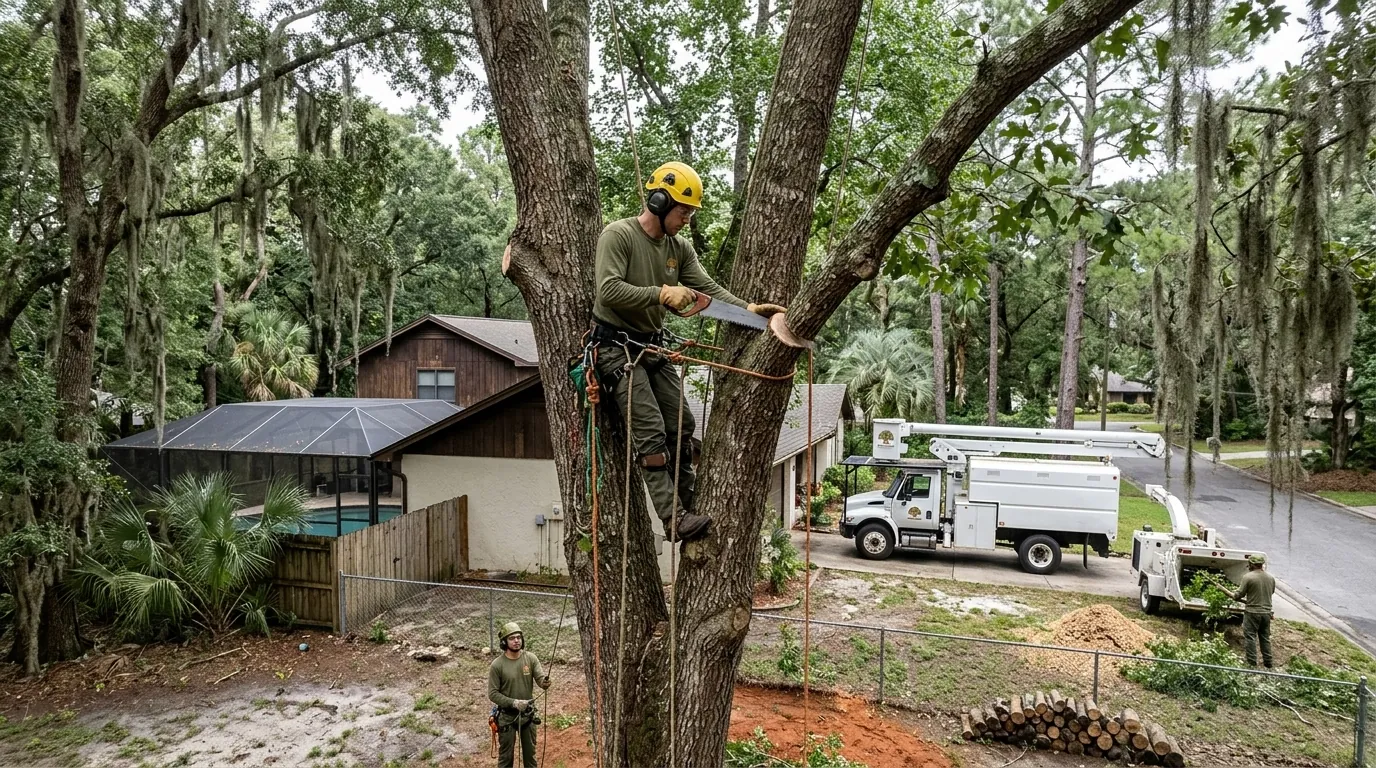
On mature oaks, the fix for a codominant stem is usually to subordinate one side, meaning we shorten it with reduction cuts so it grows slower than its partner. Over a few years the dominant side takes the load. When the fork is already cracked or the tree is too old to shift, pruning alone may not be enough, and we will say so.
Pruning sits inside the same $175 to $900 per-tree range as general trimming. The difference is that structural work is slower and more deliberate, so the number depends on how many cuts it takes to fix the faults rather than on how much wood comes down.
| Job | Typical range | What moves the price |
|---|---|---|
| Structural prune, small shade tree | $95 – $350 | Height, number of competing leaders |
| Codominant stem subordination, mature oak | $300 – $900 | Size of the stems, rigging over the house |
| Crossing and rubbing limb correction | $175 – $450 | Number of limbs, height in the canopy |
| Storm-break cleanup cuts | $175 – $600 | How many torn limbs, hangers still in the crown |
| Crape myrtle or magnolia shaping | $175 – $400 | Trunk count, density |
These prices assume normal access and daytime scheduling. If storm-broken limbs are hanging over a house and need attention after hours, emergency rates add 25 to 50 percent. For more on what changes a quote, see our Gainesville tree trimming cost guide.
Leaves make the sugar a tree lives on, so every live branch removed is a small loss of income. City guidance limits any single pruning to a quarter of the crown, and the county code bans over-pruning that strips shade for no reason. On mature trees we typically stay well under that ceiling. Old trees have less energy in reserve, and a heavy cut can start a slow decline that shows up two or three summers later.
That's why pruning works best as a cycle. A mature shade tree that gets a modest pass every three to five years stays in better shape than one that gets ignored for fifteen years and then hacked hard. Young trees are the exception: they need more frequent attention, covered on our young tree pruning page.
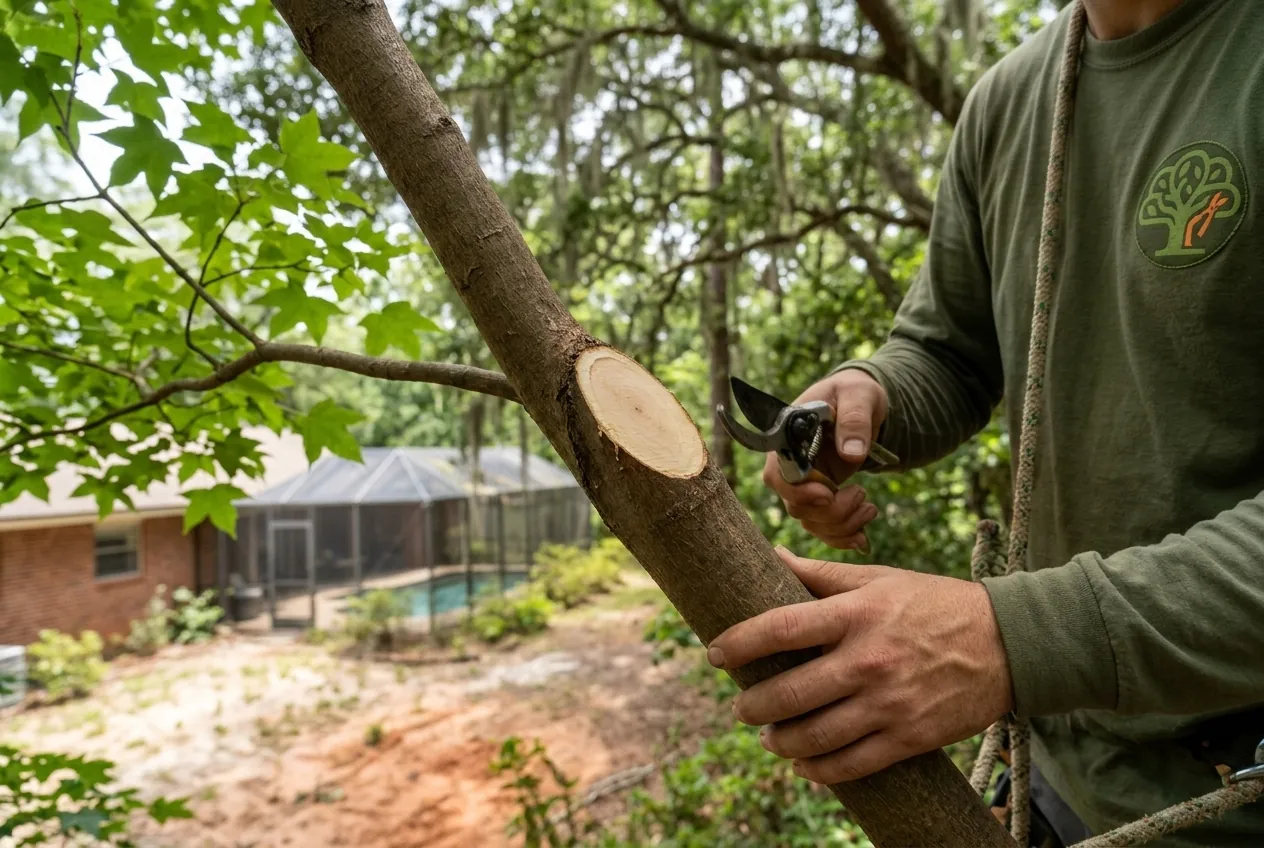
Structural pruning can happen any month here, but some windows are easier on the tree. Late winter, before the spring flush, lets us see branch structure on deciduous trees like sweetgum and red maple. Live oaks keep their leaves through winter and drop them in a short burst in spring, so their timing is more flexible. The month-by-month version, species by species, is in our oak trimming calendar for Gainesville.
What we avoid is heavy live-wood pruning in the middle of a long dry spell, when a stressed tree has the least to work with. Dead and broken wood can come out anytime; see deadwood removal for how we handle that separately.
You don't need to climb the tree to judge a pruning job. Stand under it a day or two later and look up. Good work is almost invisible from the ground: the crown looks a little more open and balanced, and you have to hunt for the cuts. Bad work announces itself.
If you see those on a tree we pruned, call us back. If you see them from an earlier crew, we can usually clean up stubs and torn edges with proper cuts and start steering the regrowth in a better direction, though a flush cut or heavy topping can't be undone.
Inside the city, species rated High Quality, live oak, southern magnolia and longleaf pine among them, are protected as heritage trees after they reach 20 inches across. Their removal requires a permit, and pruning them is governed by the city's pruning specifications. In unincorporated areas like Oakmont and Haile Plantation, county code holds pruning to the national ANSI A300 practices. Structural pruning done properly meets both sets of rules without extra paperwork. Older city neighborhoods such as Duckpond often have large heritage-size oaks where good pruning matters even more.
Pruning is one part of our tree trimming work across Gainesville. If your tree needs a broader trim with clearance and deadwood work as well, see tree trimming. To get a price, send photos or schedule a visit through the estimate form.
Reply in 1 business day
Quick estimate
Takes about 30 seconds.
We'll call you within one business day. If a tree or limb is on your house right now, call (352) 301-4164 and we'll move you up.
Trimming Services
Areas We Serve
How We Prune
Plain answers up front.
Structural pruning corrects the way a tree is built. It removes or shortens competing leaders, crossing limbs, clustered branches and oversized low limbs so the tree develops one strong trunk and well-spaced scaffold branches. It is most effective on young and middle-aged trees, but mature trees benefit too.
Generally no. Paints and sealers don't keep rot out, and they can hold moisture against fresh wood. A well-placed cut just outside the branch collar is the best protection a tree can get.
Sometimes. If one side of a fork is small enough, reducing or removing it can take the strain off. If the crack runs deep or the tree is large and old, pruning alone may not be enough, and we will tell you honestly what the options are.
For most grown shade trees here, one visit every three to five years is about right. Fast-growing species near a house may need it more often, and young trees benefit from attention every two or three years, while their limbs are still thin.
Yes, with some care. Oaks can be pruned year-round here. We avoid heavy cuts during long dry spells, because a drought-stressed tree recovers more slowly. Dead and broken wood can come out in any month.
It is the slightly swollen ring of tissue where a branch joins the trunk or a larger limb. Cutting just outside it leaves the tree's natural defenses in place so it can seal the wound with new wood.
Often paired in one climb.
All servicesFull-tree trimming done to arborist pruning standards, not hacked.
$175–$900Lets light and wind through dense oak and magnolia canopies.
$250–$900Lifts low limbs over roofs, drives, walks and pool cages.
$175–$650Shortens heavy ends without topping the tree.
$300–$1,200End-weight reduction and clearance for big live oaks.
$300–$1,400Dead fronds and seed stalks off, green fronds left alone.
$85–$275Dead limbs out before they fall on the roof or the car.
$150–$700Pre-season pruning that lowers wind load on big trees.
$250–$1,100Fewer cuts, better placed, and a tree that stays strong.