Reply in 1 business day
Quick estimate
Takes about 30 seconds.
Request received
We'll call you within one business day. If a tree or limb is on your house right now, call (352) 301-4164 and we'll move you up.

Pruning & shaping · Gainesville & Alachua County, FL
We trim the whole tree with a plan: dead limbs out, roof and driveway cleared, heavy ends shortened and the crown left full and natural. You see the list of cuts and the price on paper before a saw starts.
A lot of tree work in town gets sold as a vague afternoon of cutting. You come home, the yard is raked, and nobody can quite say what came off or why. Our approach is the opposite. Before we price a trim, we walk the tree with you and sort every cut into a purpose: safety, clearance, structure or storm load. If a cut doesn't serve one of those four, it doesn't happen.
That planning matters more here than in most places. Gainesville sits under a heavy oak and pine canopy, summer storms roll through most afternoons from June into September, and plenty of houses were built right up against trees that were already big when the slab was poured. A good trim keeps those trees working for the house: shade on the west wall, a dry roof, a clear path for the car and fewer limbs on the lawn after a squall line.
Most single trees in the Gainesville area cost $175 to $900 to trim. The spread comes down to height, how much rigging the job needs, what sits under the tree and how many distinct tasks we are doing in one climb. The ranges below are typical for homes in town and the surrounding county. Your written quote lists the actual cuts, so you can compare it line for line against anyone else's.
| Job | Typical range | What moves the price |
|---|---|---|
| Crown raise over drive, walk or roof | $175 – $650 | Number of limbs, height of the lift, traffic below |
| Deadwood cleanout | $150 – $700 | How much dead wood, what it hangs over |
| Crown thin, oak or magnolia | $250 – $900 | Canopy size, interior access, density |
| Crown reduction | $300 – $1,200 | Height and spread, number of reduction cuts, rigging |
| Live oak end-weight reduction | $300 – $1,400 | Limb length over the house, how many leaders |
| Palm trim (dead fronds, seed stalks) | $85 – $275 per palm | Palm height, species, tool sanitizing between palms |
| Young tree structural prune | $95 – $350 | Tree size, number of competing leaders |
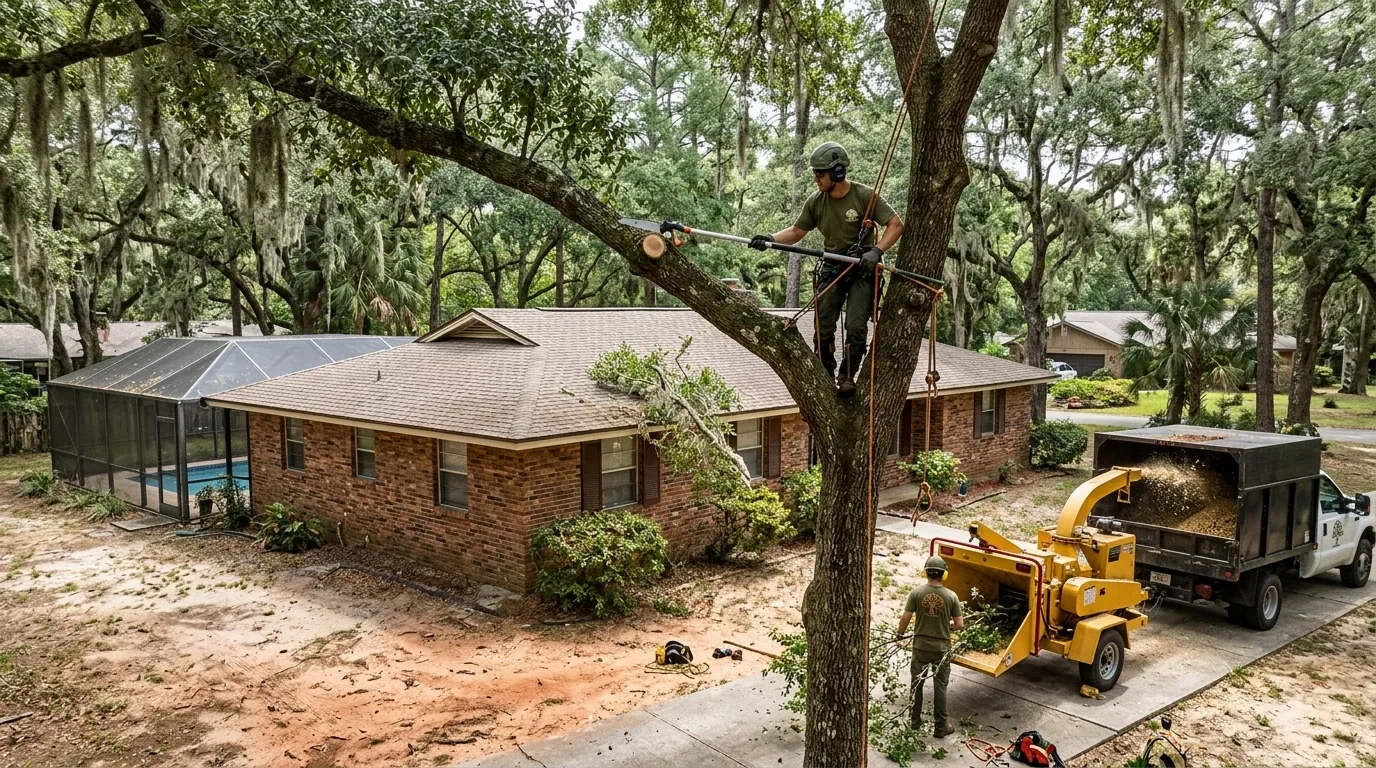
Two or three trees on one visit nearly always cost less per tree, because the truck, chipper and crew setup are already paid for. Backyard trees behind a narrow gate, limbs tangled around the service line and lots with nowhere to park the chipper push a quote up. For a deeper breakdown of how these numbers are built, read our guide to what tree trimming costs in Gainesville.
"Trim the tree" can mean very different jobs, and each one uses a different technique. Most visits combine two or three of them. Here is how we break the work down, with a page on each if you want the detail.
Two tree types get their own pages because we trim so many of them. Big yard oaks usually need live oak trimming that focuses on end weight and clearance, and palms need palm tree trimming that leaves the green fronds alone. Newly planted shade trees do best with young tree pruning every few years while their branches are still pencil-thin.
The same saw cut affects different trees in different ways, so the plan changes with the species. Live oaks are tough and wind-firm and handle a measured reduction well. Laurel oaks and water oaks grow fast and decay fast; UF/IFAS gives laurel oak a typical life of 50 to 70 years in a yard, so we keep cuts on them small and plan for the day the tree may need to come out. Southern magnolias carry a dense, low skirt that crowds front walks and shades out turf.
Loblolly and slash pines usually need only their dead lower branches removed and anything rubbing the roof cut back. Sweetgums and red maples respond to light thinning. Crape myrtles get shaped, not chopped to knuckles. Sabal palms and queen palms get their dead fronds and seed stalks removed and nothing more. One crew handles all of it on a single visit, which is how most yards in Northwood or Haile Plantation end up getting done.
A routine trim on a house lot doesn't usually need a permit, but the rules behind it change at the city line. The City of Gainesville's Urban Forestry program caps crown removal at 25 percent per pruning and refers to the pruning specifications in its Land Development Code. Inside the city, live oaks, southern magnolias and the other species on its High Quality list count as regulated heritage trees from 20 inches thick, taken at chest height (4.5 feet). Removal of those trees needs a permit. Pruning them to standard does not, but over-cutting one is the kind of thing that draws attention.
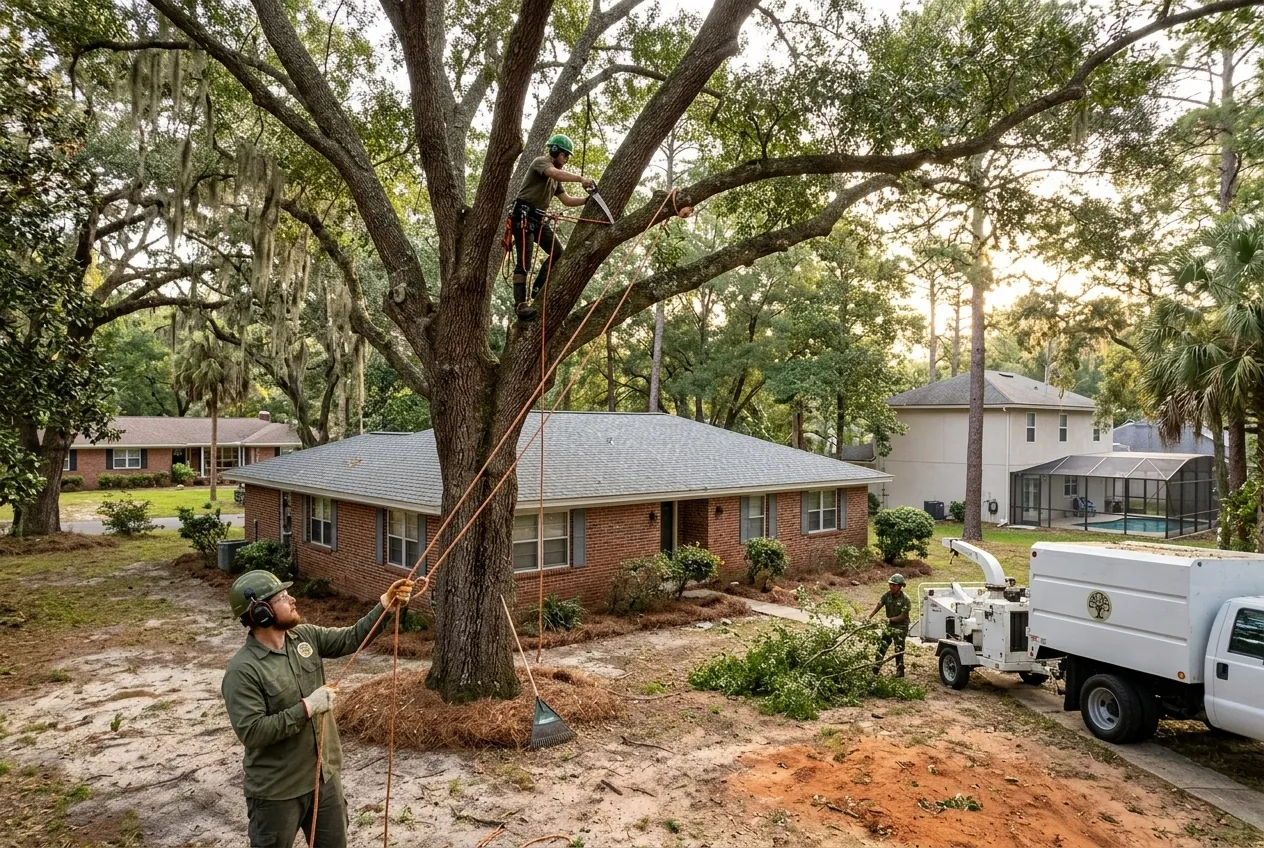
In unincorporated communities like Jonesville and Tioga, Alachua County's Unified Land Development Code applies. The county prohibits excessive pruning that needlessly cuts shade, requires pruning to follow the ANSI A300 tree care standard, and bars pruning inside designated buffers and conservation areas without county approval. Many subdivisions also have an HOA architectural committee. Our article on tree trimming permits in Gainesville covers both sets of rules in more depth.
GRU's contract crews handle the big high-voltage lines up on the poles. Your own service drop, the wire running from the pole to the house, is another matter: GRU makes property owners responsible for limbs above it and for dead trees beside it, and it offers a free disconnect so an owner or a tree company can work near that line safely. We set up that disconnect before the climb whenever a job calls for it.
Much of the unincorporated county is on Clay Electric Cooperative instead. Clay Electric re-clears its distribution lines on a set cycle, prefers 12 to 15 feet of clearance on each side and only prunes small branches around a home's service wire. It does not clean up storm debris. Nobody on our crew works within reach of an energized primary line; those limbs belong to the utility.
Every cut lands just outside the branch collar so the tree can seal the wound. We don't top trees, and we will say so in writing; our post on why topping ruins a tree explains the reasons. If a tree is dying, hollow or leaning harder than last year, we will tell you that a trim won't fix it.
Tree trimming is the core of what we do across Gainesville and Alachua County. Single-tree jobs are welcome. Send a few photos or book a walk-through through our free estimate form.
Reply in 1 business day
Quick estimate
Takes about 30 seconds.
We'll call you within one business day. If a tree or limb is on your house right now, call (352) 301-4164 and we'll move you up.
Trimming Services
Areas We Serve
How We Prune
Plain answers up front.
Expect $175 to $900 for most single trees. A crown raise on a small tree lands near the bottom, and a large live oak that needs climbing, rigging and end-weight reduction over a roof can reach the top. Several trees on one visit lower the per-tree cost. The written quote lists every cut and the total before anyone climbs.
People use the words interchangeably. We use trimming for the whole job on a tree, and pruning for the individual structural cuts that correct its build. A typical trim includes some pruning, plus clearance, deadwood and sometimes reduction work.
Gainesville's Urban Forestry guidance puts the ceiling at a quarter of the crown in a single pruning, and we hold to that limit everywhere we work. Many trims take far less. If a tree needs more than that, we split the work across two visits a season or more apart.
Yes. We trim in county communities as well as inside city limits. The county's land development code applies there instead of the city's; it ties pruning to the national ANSI A300 standard and limits excessive pruning, which matches how we already work.
Not when the cuts are made correctly and the dose is kept reasonable. Clean cuts just outside the branch collar seal over well. Big cuts on laurel and water oaks can let decay in, so on those species we keep cuts small and prefer more frequent, lighter visits.
Yes. Nothing gets left in a pile: branches are chipped, logs go on the truck, and we rake and blow the yard before leaving. Mention it at the estimate if you'd like a pile of chips for the beds or logs cut to fire-pit length.
Often paired in one climb.
All servicesSelective cuts that fix structure and keep the tree healthy.
$200–$950Lets light and wind through dense oak and magnolia canopies.
$250–$900Lifts low limbs over roofs, drives, walks and pool cages.
$175–$650Shortens heavy ends without topping the tree.
$300–$1,200End-weight reduction and clearance for big live oaks.
$300–$1,400Dead fronds and seed stalks off, green fronds left alone.
$85–$275Dead limbs out before they fall on the roof or the car.
$150–$700Pre-season pruning that lowers wind load on big trees.
$250–$1,100Every cut listed, one fixed price, yard left clean.