Reply in 1 business day
Quick estimate
Takes about 30 seconds.
Request received
We'll call you within one business day. If a tree or limb is on your house right now, call (352) 301-4164 and we'll move you up.

Safety & storm prep · Gainesville, FL
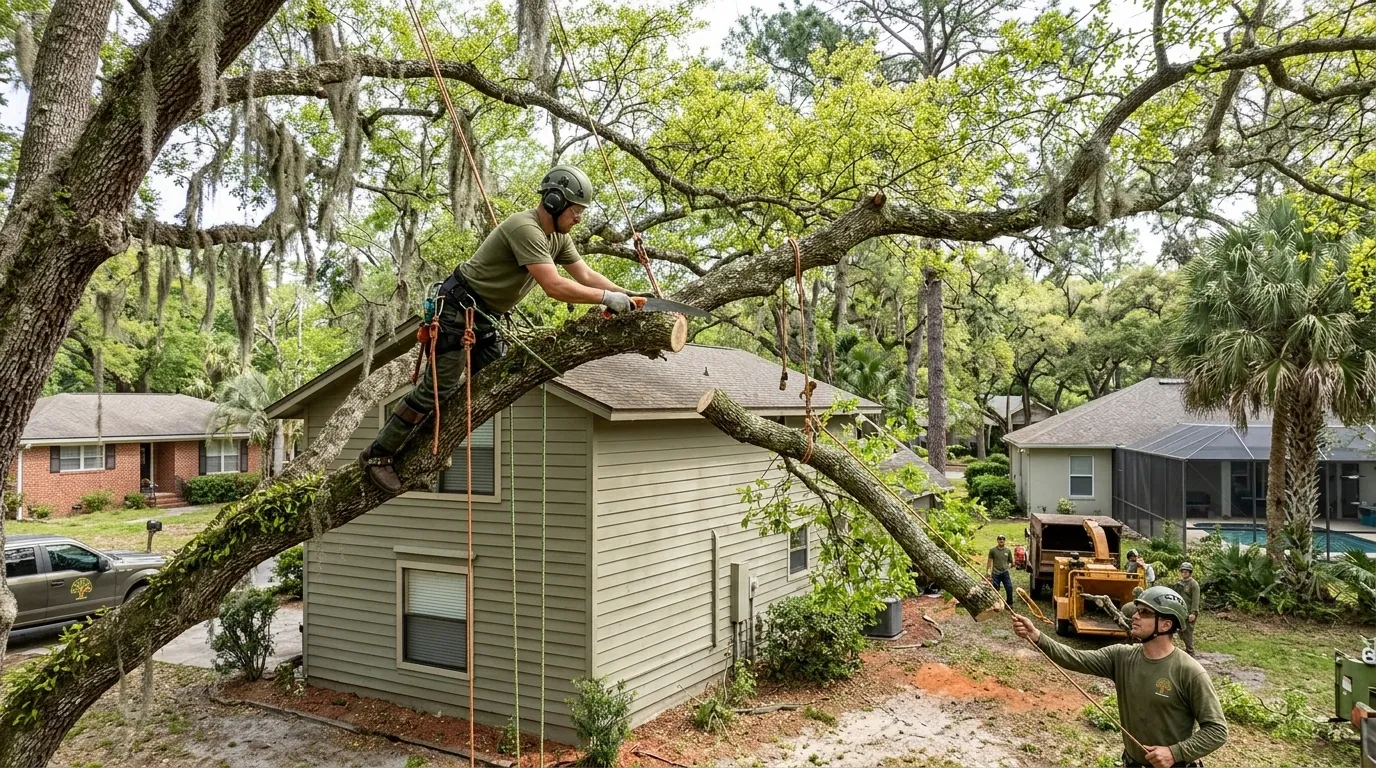
Pruning in the spring, before hurricane season opens on June 1, is the cheapest storm protection a big tree can get. We take out dead wood and hangers, shorten the longest limbs over the house and leave the crown full enough to stay healthy.
The Atlantic hurricane season runs from June 1 to November 30, and inland Gainesville is not out of reach. Hurricane Irma in 2017 and Hurricane Idalia in 2023 both brought down trees and knocked out power across Alachua County. On top of that, ordinary summer thunderstorms here regularly throw gusts strong enough to snap a weak limb. Storm prep pruning is about lowering the odds that your trees are the ones that fail.
No pruning makes a tree storm-proof. What it can do is remove the parts most likely to break, reduce the leverage on the parts that stay, and give you a good look at whether a tree has problems that pruning can't fix. That last part is sometimes the most valuable thing you get from the visit.
Much of the useful research on this subject comes from the University of Florida. In UF wind studies on live oaks, crowns that had been reduced or thinned moved less in high wind than unpruned crowns, while crown raising did not reduce trunk movement. Their conclusion was that the upper foliage is what drives the sway. A UF review of pruning research also reported that crown reduction was more effective than thinning or raising at lowering the bending load on the trunk.
That is why our storm prep work leans on crown reduction of the longest and highest limbs, with even crown thinning as a supporting step. Lifting low limbs off the roof is still worth doing for clearance, but it isn't a wind strategy.
UF/IFAS hurricane surveys put live oak, sand live oak, sabal palm and southern magnolia near the top of Florida's native species for wind tolerance. Laurel oaks came through those same storms at noticeably lower survival rates than live oaks, and sand pine is one of the least wind-resistant trees in Florida. Water oak also tends to rank poorly. If your yard is dominated by older laurel or water oaks close to the house, storm prep may include an honest conversation about which trees to keep.
Storm prep pruning usually costs $250 to $1,100 per tree. It combines several jobs, so the price depends on how much dead wood is in the crown, how many long limbs need reduction and how much of the work has to be rigged over a roof.
| Job | Typical range | What moves the price |
|---|---|---|
| Deadwood and hanger cleanout only | $150 – $700 | Amount of dead wood, height |
| Storm prep, mid-size oak | $250 – $600 | Number of limbs over the roof |
| Storm prep, large live oak or laurel oak | $600 – $1,100 | Crown spread, rigging, weak forks |
| Palm cleanup before storm season | $85 – $275 per palm | Height, seed stalks, dead fronds |
| Cabling a weak fork | $350 – $1,200 | Size of the stems, hardware needed |
These prices are for scheduled spring work. After a storm, emergency calls for limbs on a structure carry a 25 to 50 percent after-hours premium, and crews are stretched thin. Booking early is cheaper and gets you on the calendar before everyone else calls.
January through May is the ideal window. Deciduous trees are bare in January and February, so structure and dead wood are easy to see. Live oaks shed and regrow leaves in spring, and finishing work before June means trees go into hurricane season lighter. Our post on hurricane-season pruning for live oaks covers that timing in more detail.
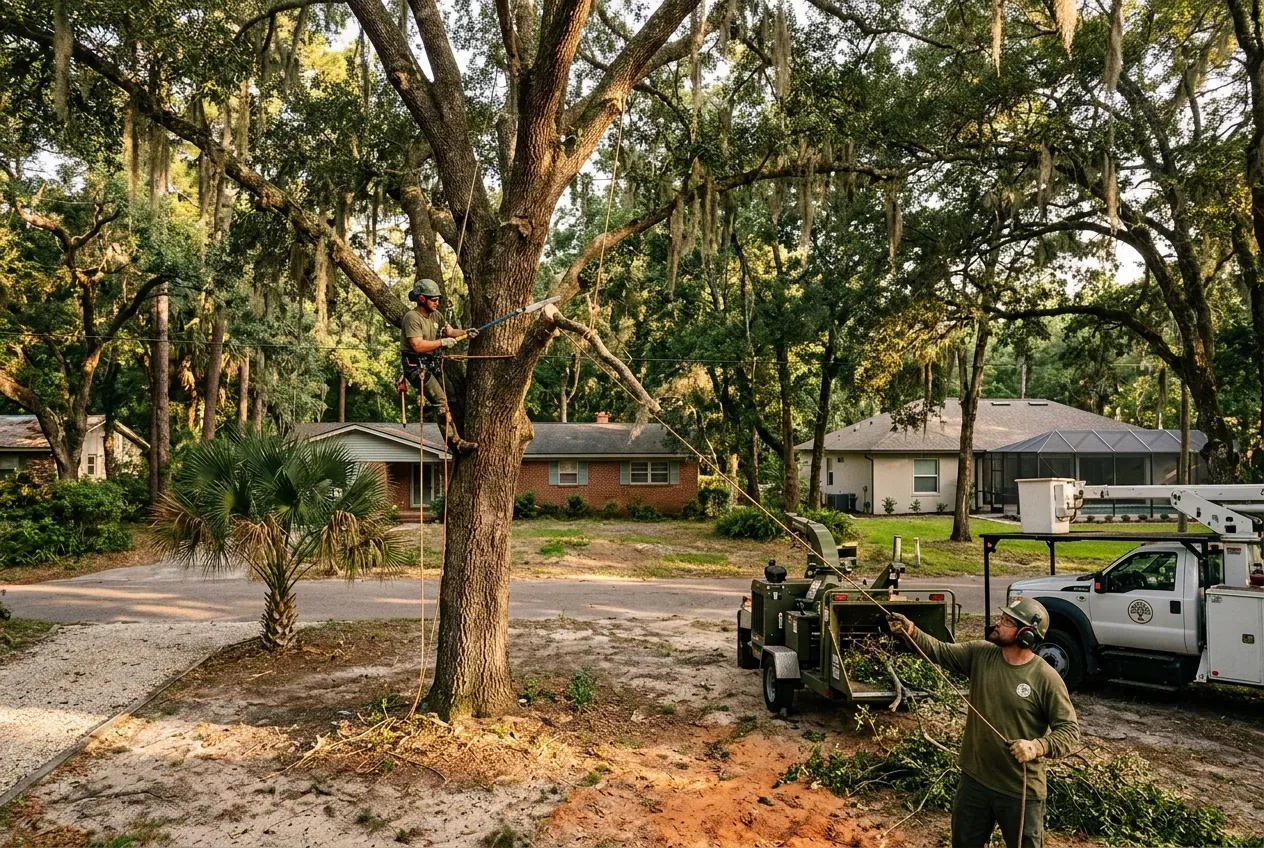
Work during the season is still worthwhile. If a storm is already forecast, though, it is too late for structural pruning; crews will be focused on emergency response, and fresh cuts won't change much in a few days. The most useful last-minute step is clearing dead fronds and loose dead limbs that could become projectiles.
Before you call anyone, a slow walk around the yard tells you a lot. These are the warning signs worth photographing and sending with your estimate request.
Any of those points to a tree that needs a closer look before June. Some can be handled with pruning, some need hardware such as a cable across a weak fork, and a few mean the tree should come down. A pre-season visit sorts them out while there is still time to schedule the work at normal rates.
Also note which trees sit closest to the house, the bedrooms and the cars, and which way they would fall. A large tree on the north side of a lot with nothing under it may be a lower priority than a smaller one leaning over the kids' rooms. We use the same logic when we suggest which trees to work on first if the budget doesn't cover everything in one season. Spreading storm prep across two or three springs is a perfectly reasonable plan, as long as the highest-risk trees go first.
It is not topping. Cutting a tree back to stubs before storm season produces weak, fast-growing sprouts that break easily in the next storm, and it starts decay at every cut. Our article on why you should never top a tree lays out the problems. It is also not a hurricane cut on palms, which UF/IFAS says leaves the bud exposed behind a handful of soft new fronds. Our palm tree trimming page explains what to remove instead.
Storm prep near power lines follows the same rules as any other trimming. Where GRU is the utility, the branches above your service drop are yours to maintain, and a free GRU disconnect makes that work safe. Clay Electric handles its own lines on its maintenance cycle and doesn't clean up storm debris afterward. We do storm prep throughout Gainesville and in towns like Newberry and Archer, as well as neighborhoods such as Millhopper with tall oaks over older homes. Request a pre-season walk-through through our estimate form.
Reply in 1 business day
Quick estimate
Takes about 30 seconds.
We'll call you within one business day. If a tree or limb is on your house right now, call (352) 301-4164 and we'll move you up.
Trimming Services
Areas We Serve
How We Prune
Plain answers up front.
January through May is ideal. Hurricane season runs June 1 to November 30, and spring work lets trees go into the season lighter while crews are still easy to book.
It reduces the risk; it doesn't eliminate it. Live oaks in UF wind studies swayed less after thinning or reduction than unpruned trees did. Removing dead wood and hangers takes away the parts most likely to fly.
No. UF/IFAS cautions that this leaves the palm's single bud guarded only by a few tender new fronds. Remove dead fronds and seed stalks only and leave the green crown.
UF/IFAS surveys found laurel oak survival significantly lower than live oak, and sand pine among the least wind-resistant trees. Live oak, sand live oak, sabal palm and southern magnolia hold up best.
For structural pruning, usually yes. In the days before a storm, focus on loose dead limbs and dead palm fronds. Plan the larger work for the following spring.
Most trees run $250 to $1,100 depending on dead wood, the number of long limbs over the house and how much rigging is needed. Palms are $85 to $275 each.
Often paired in one climb.
All servicesFull-tree trimming done to arborist pruning standards, not hacked.
$175–$900Selective cuts that fix structure and keep the tree healthy.
$200–$950Lets light and wind through dense oak and magnolia canopies.
$250–$900Lifts low limbs over roofs, drives, walks and pool cages.
$175–$650Shortens heavy ends without topping the tree.
$300–$1,200End-weight reduction and clearance for big live oaks.
$300–$1,400Dead fronds and seed stalks off, green fronds left alone.
$85–$275Dead limbs out before they fall on the roof or the car.
$150–$700Prune in spring, sleep better in September.