Reply in 1 business day
Quick estimate
Takes about 30 seconds.
Request received
We'll call you within one business day. If a tree or limb is on your house right now, call (352) 301-4164 and we'll move you up.

Safety & storm prep · Gainesville, FL
The cheapest time to fix a tree's structure is while its branches are as thin as your finger. A few well-placed cuts every few years give a new oak one strong trunk and well-spaced limbs, which is exactly what keeps it standing decades from now.
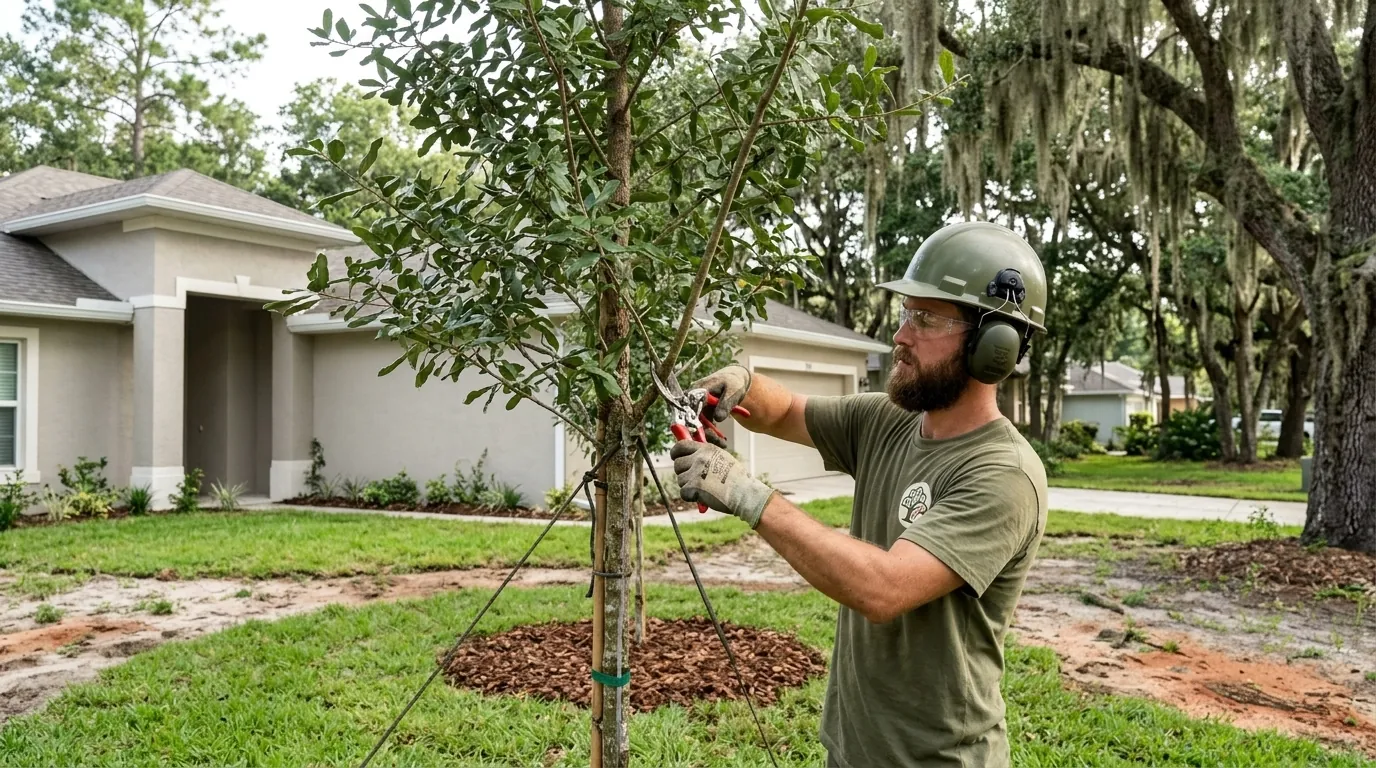
Most of the big-tree problems we deal with started when the tree was small. A split fork in a 40-year-old oak was once two pencil-thin leaders that nobody chose between. A massive low limb that now hangs over the driveway was once a twig that could have been snipped with hand pruners. Young tree pruning, also called structural training, fixes those problems while the cuts are tiny and the tree closes them in a season or two.
It's also the least expensive tree work you will ever pay for. Most young trees can be done from the ground with hand tools in well under an hour, and a handful of visits over the first couple of decades can save thousands in corrective work later.
UF/IFAS training guidance for shade trees, written by researchers based right here at the University of Florida, lays out a plan we follow closely. The core goals are short.
The same guidance advises beginning at planting and continuing for 25 years, with about seven prunings over that time. That works out to a visit every few years, more often early on and less often as the tree's structure settles.
Young tree pruning runs $95 to $350 per tree. The low end covers a newly planted tree that just needs a competing leader shortened. The high end covers a 10- to 15-year-old oak that needs a climber or a tall pole saw and has already started forming a codominant stem.
| Job | Typical range | What moves the price |
|---|---|---|
| New planting, first structural cut | $95 – $150 | Number of trees, competing leaders |
| Tree 3 to 8 years old | $125 – $250 | Height, how many leaders to subordinate |
| Tree 8 to 15 years old | $200 – $350 | Pole saw or climb needed, codominant stems |
| Several new trees, same visit | Quoted per tree | Shared trip, mostly hand tools |
Many homeowners pair a young tree visit with work on the big trees in the same yard. If you have a mature oak that also needs attention, ask about tree trimming on the same day.
Young trees can handle a larger share of foliage removal than old ones, but there are still limits. The UF/IFAS training plan sets caps that change with age: no more than 25 percent of live foliage at planting, up to 40 percent around year two on trees with several leaders to sort out, about 35 percent at year four, and 25 to 35 percent around year eight. Most visits take far less.
Inside the city there is one more rule we apply to every young tree: pruning should never leave more than a third of the trunk without branches. Many of the branches on a young tree are temporary and will eventually come off as the tree grows, but they stay on for now because they feed the trunk and help it thicken. We shorten them gradually instead of stripping the trunk all at once. The crown raising page explains how that lifting continues as the tree matures.
Newer subdivisions around the edges of town, including parts of Tioga and Jonesville, were planted with rows of young street and yard trees, often live oaks and other shade species. They are all at the age where a little training makes the biggest difference. HOAs sometimes maintain common-area trees but leave yard trees to the owner, so it's worth checking which trees are yours.
Inside the city, new trees planted to replace removed heritage trees must meet minimum nursery standards: the city's mitigation rules call for nursery-grown trees roughly 2 inches thick that meet Florida Nursery Grade #1. A good nursery tree with a single leader takes far less training. Even so, it will still need structural pruning as it grows. UF/IFAS notes that less frequent pruning may be needed when you start with quality nursery trees and water them until they are established.
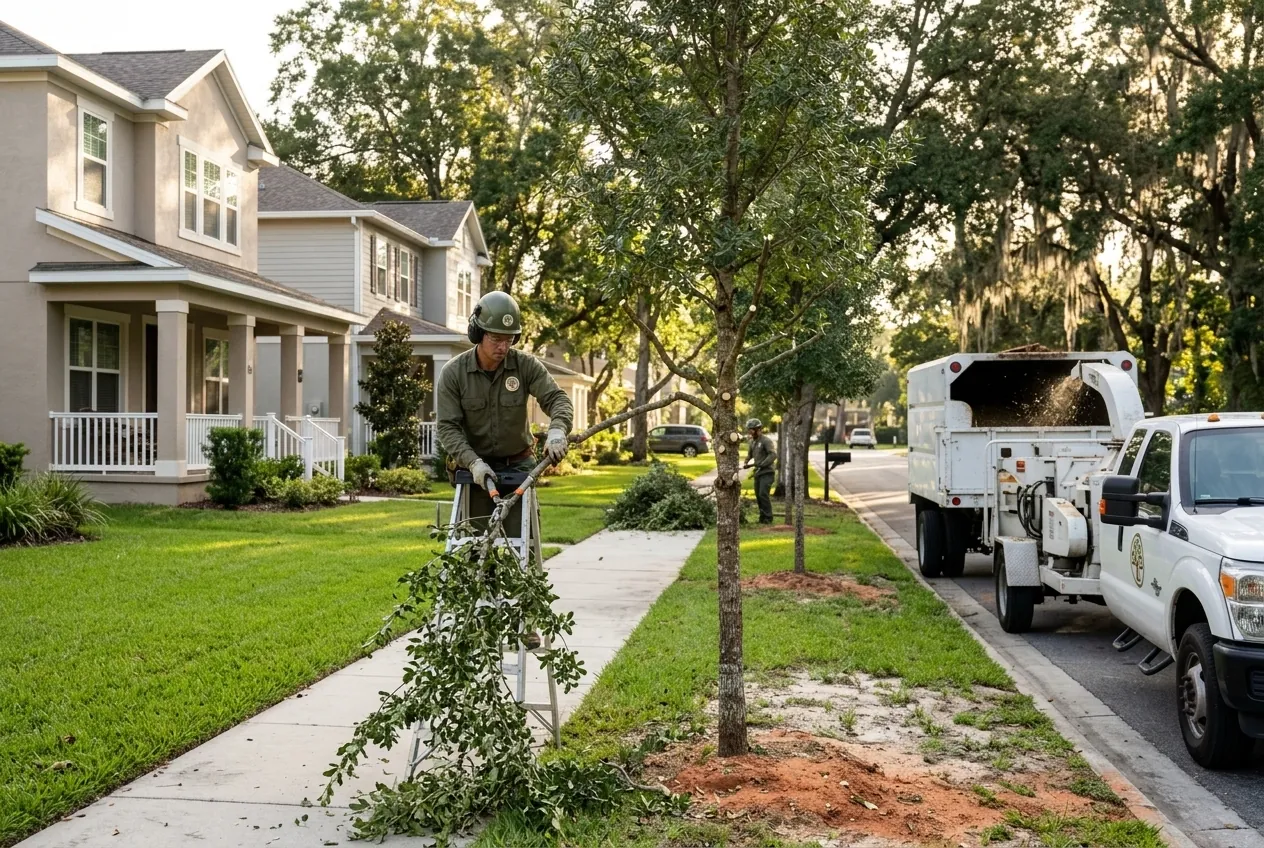
Well-meaning owners make a few predictable mistakes with new trees. The most common is stripping off every low branch in the first year to get a clean trunk. Those lower branches feed the trunk and help it thicken and taper, so removing them early leaves a skinny, whippy tree that leans in the wind. Shorten them instead and remove them over the following years.
The second is cutting the top off a young tree to keep it small. That destroys the leader you most want to keep and usually produces several new tops competing with each other, which is the start of a weak codominant fork. If a tree will outgrow its space, the better fix is choosing a smaller species now.
The third is leaving nursery stakes and ties on for years. Ties can girdle a growing trunk, and a tree that is never allowed to sway grows a weaker trunk. Once roots are established, usually within the first year or so for small trees, the stakes should come off. We check for this on every young tree visit and remove old hardware at no extra charge.
We start by picking the leader, the single stem that will become the main trunk, and look up the tree from each side to find anything competing with it. Competing stems get shortened, not removed, so they still contribute leaves while they fall behind. Next we look for clusters where several branches leave the trunk at one height and choose the best of them. Finally we shorten any low branch that is growing faster than its neighbors. On most young trees that adds up to a handful of cuts, all small enough for hand pruners or a pole saw, and the whole visit is done in minutes.
If you are planting new trees, species choice is your biggest storm decision. UF/IFAS hurricane surveys found live oak, sand live oak, southern magnolia and sabal palm among the most wind-tolerant natives, while laurel oak and sand pine performed poorly. A young live oak trained to a single leader is about as close to a long-term storm investment as a Gainesville yard can get. Our live oak trimming page covers how those trees are maintained once they're grown.
Young tree pruning is part of our tree trimming service across Gainesville. Species-by-species timing is covered in when to trim oak trees in Gainesville. To schedule a structural prune, send us a photo of each young tree through the estimate form.
Reply in 1 business day
Quick estimate
Takes about 30 seconds.
We'll call you within one business day. If a tree or limb is on your house right now, call (352) 301-4164 and we'll move you up.
Trimming Services
Areas We Serve
How We Prune
Plain answers up front.
At planting. UF/IFAS training guidance recommends shortening or removing any leaders competing with the best central stem right away, and removing broken or damaged branches.
Every few years for the first couple of decades. The UF/IFAS training plan schedules about seven prunings in the first 25 years, with more frequent visits early on.
Not yet. Low temporary branches help the trunk thicken. Shorten them gradually instead of removing them all at once. City of Gainesville guidance keeps at least two-thirds of a young trunk carrying branches.
It's two trunks of roughly equal size growing from the same point. The fork between them is weak and often splits as the tree grows. Shortening one stem early lets the other become the single leader.
Usually $95 to $350 per tree, depending on size and how much correction it needs. Grouping several young trees into one visit brings each one's price down.
No. Routine structural pruning of young trees doesn't require a permit in the City of Gainesville or unincorporated Alachua County.
Often paired in one climb.
All servicesFull-tree trimming done to arborist pruning standards, not hacked.
$175–$900Selective cuts that fix structure and keep the tree healthy.
$200–$950Lets light and wind through dense oak and magnolia canopies.
$250–$900Lifts low limbs over roofs, drives, walks and pool cages.
$175–$650Shortens heavy ends without topping the tree.
$300–$1,200End-weight reduction and clearance for big live oaks.
$300–$1,400Dead fronds and seed stalks off, green fronds left alone.
$85–$275Dead limbs out before they fall on the roof or the car.
$150–$700Small cuts now, strong trees later.