Reply in 1 business day
Quick estimate
Takes about 30 seconds.
Request received
We'll call you within one business day. If a tree or limb is on your house right now, call (352) 301-4164 and we'll move you up.

Pruning & shaping · Gainesville, FL
When a tree has outgrown its spot, we bring the height or spread back with cuts to healthy side branches. The tree keeps a natural shape, the heavy ends get lighter, and nothing is left as a stub.
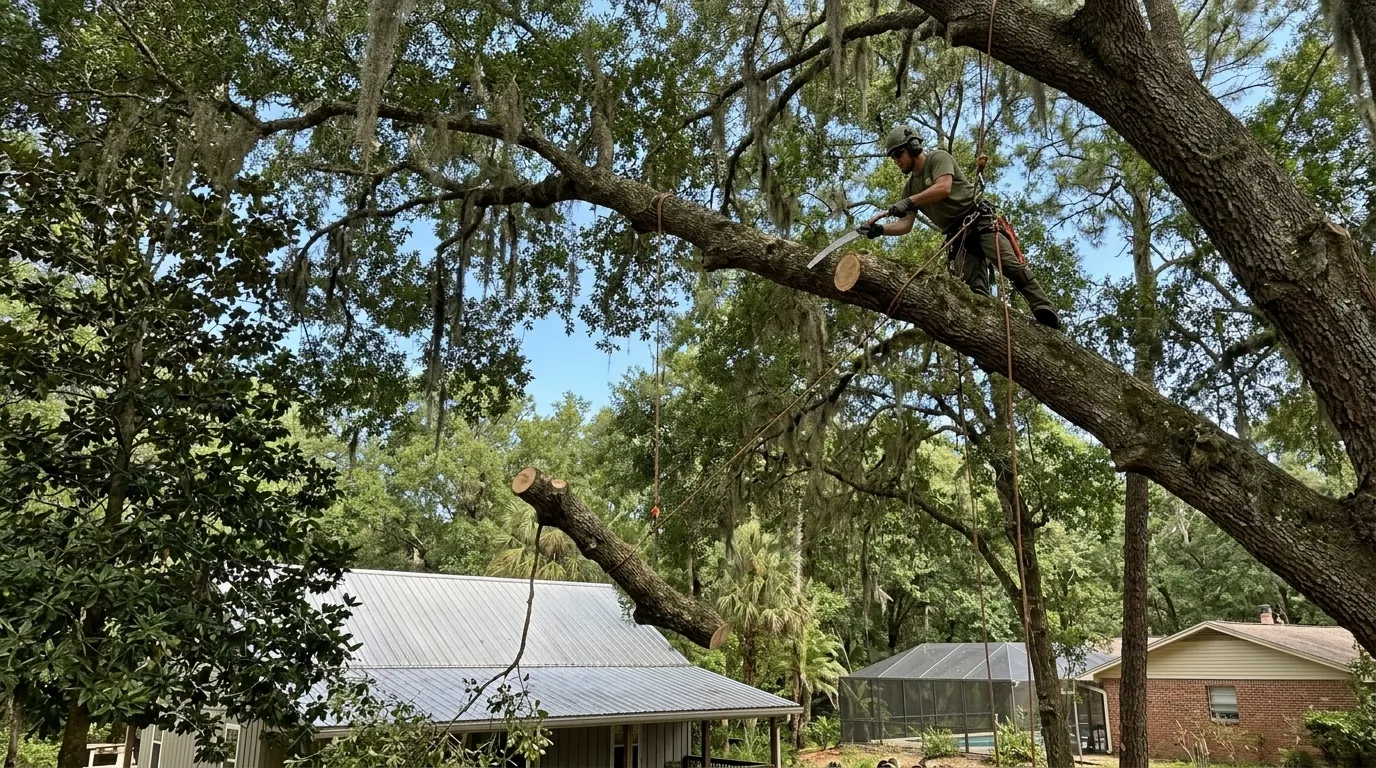
Crown reduction makes a tree smaller in height, in spread or both. It's the right job when long limbs reach over the roof, a tree is crowding a neighbor's house, or a tall crown is carrying too much weight at the top. Done properly, the tree ends up a size or two smaller with the same general shape. Done badly, it ends up topped, which is the single most damaging thing commonly done to shade trees in Florida.
The difference is entirely in the cuts. A reduction cut brings a limb back to a living lateral, and that lateral becomes the limb's new end. Topping chops through limbs wherever the crew wants the height to be, leaving stubs with nothing to take over. One leaves a tree that keeps growing normally. The other leaves a tree that rots at the stubs and sprouts a thicket of weak shoots.
Each reduction cut follows a simple rule found throughout ANSI-based pruning guidance: the side branch you cut back to should be at least one-third the diameter of the stem being removed. A 3-inch limb gets cut back to a lateral at least 1 inch across. Smaller than that, and the side branch usually can't pull enough sap to keep the tip alive, so the end dies back and decays.
A reduction usually takes a few feet off the ends, not a third of the tree. If a tree truly needs to be half its size, reduction alone can't get there without destroying it, and that is a conversation about replacing it with a better-fitting tree instead.
Crown reduction runs $300 to $1,200 per tree in most of Alachua County. It is more expensive than raising or a light thin because every cut has to be placed precisely, often from the outer edge of the canopy, and many limbs have to be lowered on ropes to protect what is underneath.
| Job | Typical range | What moves the price |
|---|---|---|
| Reduce limbs off one side of the roof | $300 – $650 | Number of limbs, roof pitch below |
| Overall height reduction, mid-size tree | $450 – $900 | Tree height, how many leaders |
| Full crown reduction, large oak | $700 – $1,200 | Spread, rigging, access for the chipper |
| Pull limbs back from the service drop | $300 – $700 | Coordinating a utility disconnect |
| Crane assist if needed | Add $600 – $1,800 | Only for limbs that can't be rigged safely |
For big oaks with long horizontal limbs, the specialized version of this job is live oak trimming focused on end weight. If the issue is low limbs rather than long ones, crown raising is cheaper and faster.
Leaves and branch ends near the top and outer edge of a crown catch the most wind. Live oaks tested at UF under hurricane-force wind swayed less after reduction or thinning, and a UF review of other studies found reduction did the most to cut the bending stress at the trunk. Shortening the ends of the longest limbs is one of the most useful things you can do for a big tree near a house before storm season.
That doesn't mean reduction makes a tree storm-proof. A tree with decay at its base or a cracked fork can fail no matter how well its crown is shaped. But on a sound tree, a modest reduction a few months before June is solid insurance. See storm prep pruning for how we plan that work, and our live oak storm-season pruning article for timing.
Live oaks handle careful reduction very well and reliably put out new growth from the laterals left behind. Southern magnolias and most pines tolerate light reduction on individual limbs. Laurel and water oaks are the tricky ones. Their wood decays quickly behind larger cuts, and UF/IFAS notes laurel oaks often become hazardous in urban settings after 50 to 70 years. On those species we keep reduction cuts small and spread the work over more frequent visits.
Pines are a special case. Cutting the top out of a pine destroys its leader and rarely ends well. If a pine is simply too tall for its spot, reduction is not the answer.
Reduction is the right tool for limbs growing toward a wire, because it lets us choose which way the new growth points. Cutting back to a side branch that angles away from the line trains the limb to grow away rather than straight back into it. This is often called directional pruning, and utility line-clearance crews use the same principle.
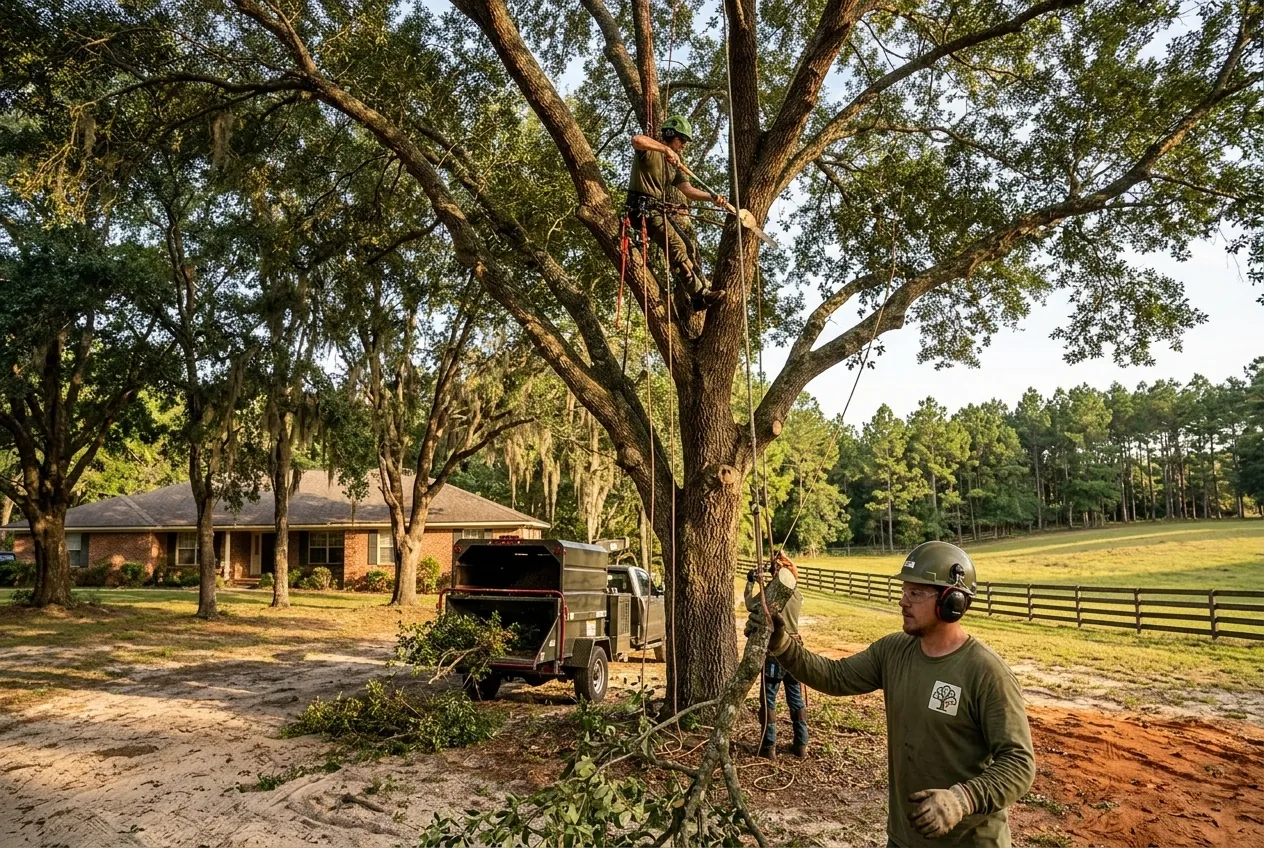
Utility rules still decide who does what. On GRU service, branches over your own service drop are on you to keep clear, and the utility will disconnect that line at no charge while a crew works. Clay Electric trims its distribution lines on a set cycle and keeps about five feet clear around a home's service wire, but only cuts small branches there. Anything close to the primary conductors up on the poles is the utility's to handle, not a private crew's.
Limbs over a property line are a different kind of boundary. A one-sided reduction that takes everything off the neighbor's side can unbalance a tree and harm it, so we look at the whole crown and suggest talking with the neighbor before cutting. Often a modest reduction on both sides solves the complaint and keeps the tree healthy.
Once a tree has been reduced, it will grow back from the laterals. A light maintenance reduction every few years keeps it at the new size with small cuts, which is far easier on the tree than waiting ten years and cutting hard.
We also ask what you want the tree to look like in five years, not just next week. A reduction planned around that answer usually means fewer, better-placed cuts today.
Topped trees are everywhere along Florida roads, so it's worth being clear. Topping removes large branches and leaders back to stubs to make a tree shorter fast. It invites decay, triggers weakly attached sprouts that grow back quickly and break easily, and usually means the tree needs more expensive work every few years after. County code forbids over-pruning that robs a tree of shade, and city pruning rules forbid practices that make trees more hazardous. For the longer case against it, read our post on topping.
We do crown reductions throughout Gainesville and outlying towns such as Newberry and Alachua, where big oaks often sit close to older homes. To get a written price, send photos showing the limbs you want brought in through our estimate form.
Reply in 1 business day
Quick estimate
Takes about 30 seconds.
We'll call you within one business day. If a tree or limb is on your house right now, call (352) 301-4164 and we'll move you up.
Trimming Services
Areas We Serve
How We Prune
Plain answers up front.
Crown reduction shortens limbs back to living side branches that take over as new tips, so the tree keeps growing normally. Topping cuts limbs back to stubs with no side branch to take over, which leads to decay and weak, fast sprouts. We only do reduction.
Usually a few feet off the ends of the limbs, staying within the City of Gainesville's 25 percent guideline. If a tree needs to lose half its size, reduction can't do that without harming it, and replacing the tree is usually the better option.
On a sound tree, yes. In UF wind work on live oaks, reduced crowns swayed less than untouched ones. It doesn't fix hidden decay or a cracked trunk, so we look for those too.
Individual long limbs, yes. Cutting the top out of a pine destroys its leader and usually leads to decline, so we don't reduce pine height.
Most jobs run $300 to $1,200. Reducing a few limbs off one side of a roof sits near the low end, and a full reduction on a large oak with heavy rigging sits near the top. A crane is only added if limbs can't be lowered safely by rope.
Yes, from the side branches left behind. A typical maintenance reduction is repeated every several years to hold the size.
Often paired in one climb.
All servicesFull-tree trimming done to arborist pruning standards, not hacked.
$175–$900Selective cuts that fix structure and keep the tree healthy.
$200–$950Lets light and wind through dense oak and magnolia canopies.
$250–$900Lifts low limbs over roofs, drives, walks and pool cages.
$175–$650End-weight reduction and clearance for big live oaks.
$300–$1,400Dead fronds and seed stalks off, green fronds left alone.
$85–$275Dead limbs out before they fall on the roof or the car.
$150–$700Pre-season pruning that lowers wind load on big trees.
$250–$1,100Shorter, lighter, still shaped like a tree.