Not sure what to ask for?
 Don’t see your street?
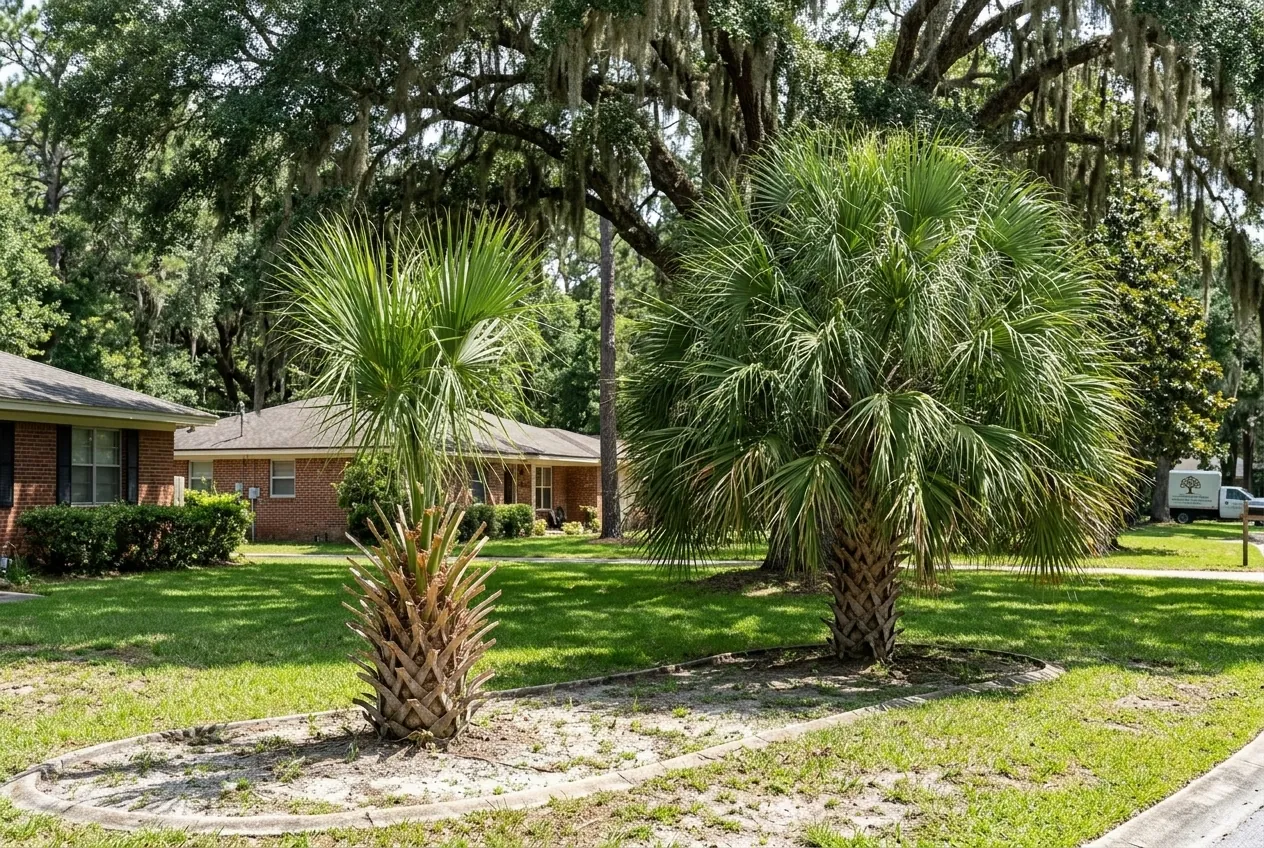
Gainesville yards mix several kinds of palms. Cabbage palms, also called sabal palms and Florida's state tree, are everywhere. Queen palms, Washingtonia fan palms, pindo palms and Canary Island date palms show up around pools and entrances. Each one has a slightly different trimming need, but the mistakes below apply to almost all of them.
Palm Trimming Mistake 1: The Hurricane Cut
A hurricane cut leaves only a narrow tuft of the newest fronds standing at the top of the trunk, usually in the belief that fewer fronds means less wind damage. UF/IFAS Extension agents describe it as a practice that harms the palm and can actually make storm damage worse. The fronds left behind are the youngest and weakest, the growing point is more exposed, and the palm loses most of the leaves it uses to feed itself.
Repeated overcutting can also cause the trunk to narrow over time on some palms, sometimes called pencil-pointing. That narrow section is a weak spot that stays with the palm for life, because palms can't add new wood to thicken a trunk the way an oak can.
The rule that fixes it
Picture the palm's crown as a clock. UF/IFAS guidance is to leave every frond above the 9 o'clock and 3 o'clock positions. Fronds that hang below horizontal and are completely brown can go. Everything at or above level stays. Our palm tree trimming service follows that rule on every palm.
Palm Trimming Mistake 2: Cutting Yellow or Half-Brown Fronds
This one trips up more Florida palm owners than any other, and it's the least obvious. Palms in sandy soils, including Gainesville's, are prone to potassium deficiency. Potassium moves inside the palm, so when it runs short, the palm pulls it out of older fronds to feed the new ones. Those older fronds turn yellow, then orange-brown along the edges.
Cutting them off seems tidy, but the palm is still drawing nutrients from them. Remove them and the palm starts pulling from the next row up, which spreads the problem higher into the crown. UF/IFAS recommends leaving partly green fronds in place and treating the deficiency with a palm fertilizer instead. Older UF/IFAS guidance specifies sulfur-coated potassium sulfate with magnesium added to avoid an imbalance. A county extension office can tell you the current product advice.
Palm Trimming Mistake 3: Using Climbing Spikes on Palms
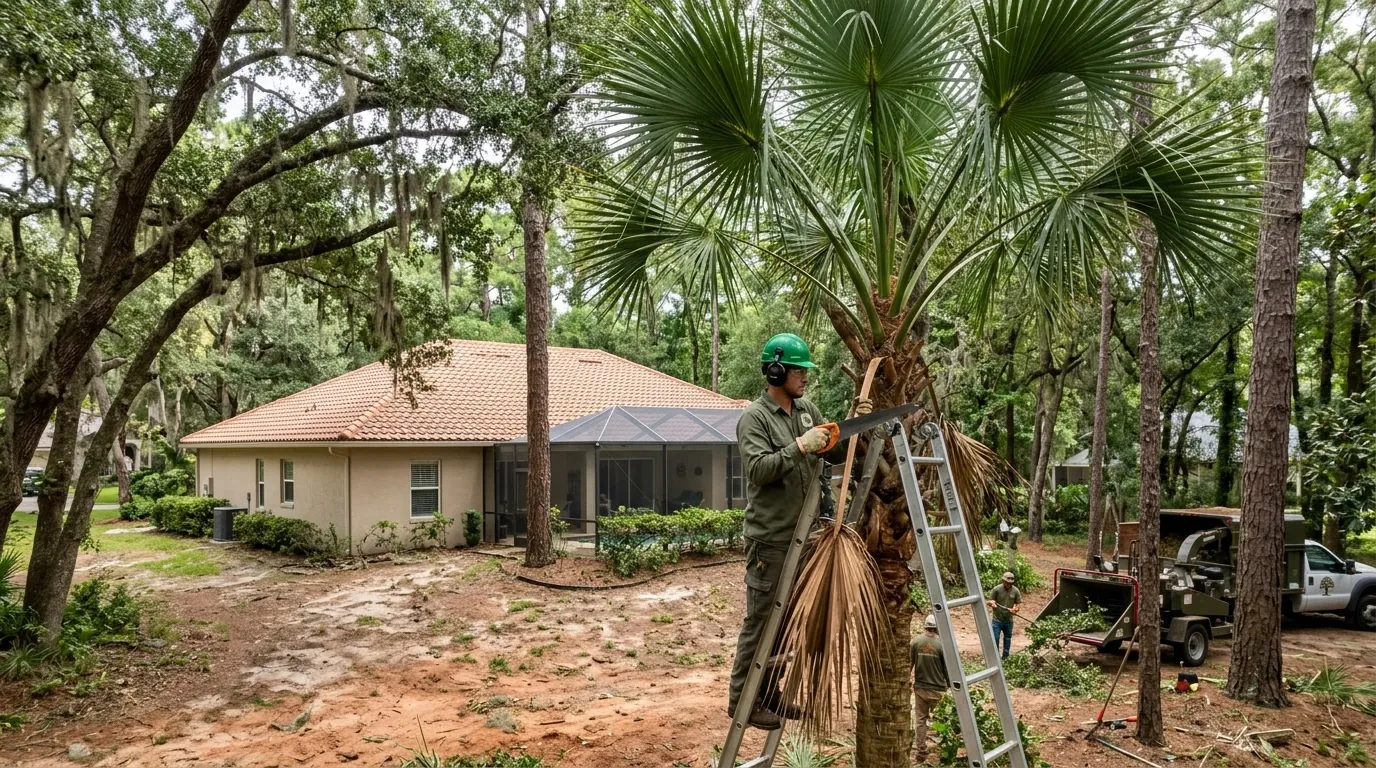
Spikes, also called spurs or gaffs, punch holes in the trunk with every step. On a pine headed for removal, that doesn't matter. On a palm that's staying, it does. Palms don't have the growth layer that lets broadleaf trees seal over wounds, so every spike hole is permanent. Those wounds can let in pests and disease and leave a trunk looking pockmarked. A healthy palm should be trimmed from a lift, a ladder or with tree-safe climbing gear, not spikes.
Palm Trimming Mistake 4: Dirty Saws and Disease
Fusarium wilt kills Canary Island date palms, queen palms and Washingtonia palms, and an infected palm can't be saved. According to UF/IFAS, it moves from palm to palm mainly on infested pruning tools, carried in sawdust left on the blade. A homeowner can lose a whole row of queen palms within weeks of a single careless trim.
- Clean and disinfect hand saws between palms. A quick dip isn't enough; the tool has to soak in the disinfecting solution.
- Avoid chainsaws on these palms. There's no practical way to sterilize one between trees.
- If a palm in the yard is already declining with one-sided frond death, trim the healthy palms first and that one last.
Ganoderma butt rot is a separate problem. It shows up as shelf-like conks at the base of the trunk, and there is no cure. A palm with Ganoderma will eventually fail, and it's wise not to plant a new palm in the same spot.
Palm Trimming Mistake 5: Peeling Cabbage Palm Boots
The boots are the old leaf bases that stay on a cabbage palm's trunk after the frond is cut. Some owners like the crisscross look, others prefer a clean trunk. Boots will usually loosen and drop on their own over time. Prying off boots that are still firmly attached can tear into the trunk below. If you want a smooth trunk, remove only the ones that come away easily and let the rest weather off.
Palm Trimming Mistake 6: Trimming Too Often
Many palms only need a trim about once a year, mostly to clear dead fronds and seed stalks before they become a mess on the pool deck. Trimming every few months to keep a palm looking crisp usually means green fronds are coming off. Some palms with a smooth green crownshaft drop old fronds on their own and need little or no trimming at all.
Gainesville Palm Trimming Guide by Species
| Palm | What to remove | What to leave |
|---|---|---|
| Cabbage (sabal) palm | Fully brown fronds below horizontal, seed stalks | All green and partly green fronds; firmly attached boots |
| Queen palm | Dead fronds, fruit stalks before they drop | Green fronds; use clean hand tools only |
| Washingtonia fan palm | Dead fronds if you don't want the skirt | Green fronds above 9 and 3; no spikes on tall trunks |
| Canary Island date palm | Dead fronds, fruit stalks | Green fronds; disinfected tools between palms |
| Pindo palm | Dead fronds, fruit stalks | Green fronds; leave old leaf bases unless loose |
Palm Trimming Gainesville FL Owners Can Handle Themselves
Not every palm needs a crew. A short cabbage palm or pindo palm with fronds you can reach from the ground is a reasonable weekend job, as long as you stick to a few rules.
- Cut only fronds that are completely brown and hang below horizontal. If you're unsure, leave it.
- Use a clean, sharp hand saw or loppers, and disinfect them before moving to the next palm.
- Wear gloves and eye protection. Canary Island date palms and some other species carry long, sharp spines near the base of each frond.
- Cut a few inches out from the trunk rather than flush against it, so you don't nick the trunk itself.
- Stay off ladders for anything taller than you can safely reach, and never work near a power line.
Once the work means climbing, leaning out from a ladder, or lowering heavy seed clusters over a screen enclosure, it's time to call for help. A falling frond from a tall Washingtonia can weigh more than people expect and the stalks can tear a pool screen.
Palm Trimming in Gainesville Before Storm Season
Palms are some of the toughest plants in a hurricane. The UF/IFAS fact sheet Wind and Trees notes that palms as a group survive hurricanes better than broadleaf and conifer trees, and lists sabal palm among the wind-resistant species to plant. A palm can lose all its fronds in a storm and recover, as long as the single bud at the top is intact. That's the strongest argument against the hurricane cut: the palm already has its own defense, and stripping it takes away the food it needs to recover.
Storm prep for palms is simple. Remove dead fronds and heavy seed and fruit clusters that could blow loose, and leave the green crown. If the bigger concern is an oak beside the palm, our storm prep pruning page and our live oak storm prep walkthrough cover that side.
Palm Trimming Near Pools and Power Lines
Gainesville pool cages and palms go together, and that's where a lot of palm trimming happens. Fronds and seed stalks need to be lowered, not dropped onto the screen. Palms growing into the service wire to a house are a job for a professional, and anything touching a primary line goes to the utility first. Palm trims typically run $85 to $275 per palm. Our trimming cost guide has the full price breakdown.
Palms are common across the area, from pool-cage homes in Haile Plantation to larger lots in Archer and High Springs. The same rules apply everywhere: leave green fronds, keep tools clean, and never spike a living palm.
If your palms need a trim, request a free estimate and we'll price them per palm in writing. Palm work is part of the wider tree trimming we do across Gainesville and Alachua County.